







For years, digital marketers have played a predictable game. We optimized websites, chased keywords, and more recently, started restructuring content for GEO (Generative Engine Optimization) so AI engines like Gemini would cite our brands in public searches.
We thought we were optimizing for the public web. We were wrong.
With Google’s Personal Intelligence now actively bridging the gap between a user’s private data (like Gmail) and Gemini’s search capabilities, the game has completely changed.
The AI isn’t just looking at what’s on your website anymore—it’s looking at what’s in your customers’ inboxes to decide what to show them next.
Welcome to the era of Inbox SEO. Here is how it works, and why it’s about to turn digital marketing upside down.
The Invisible Search: When Context Replaces Keywords
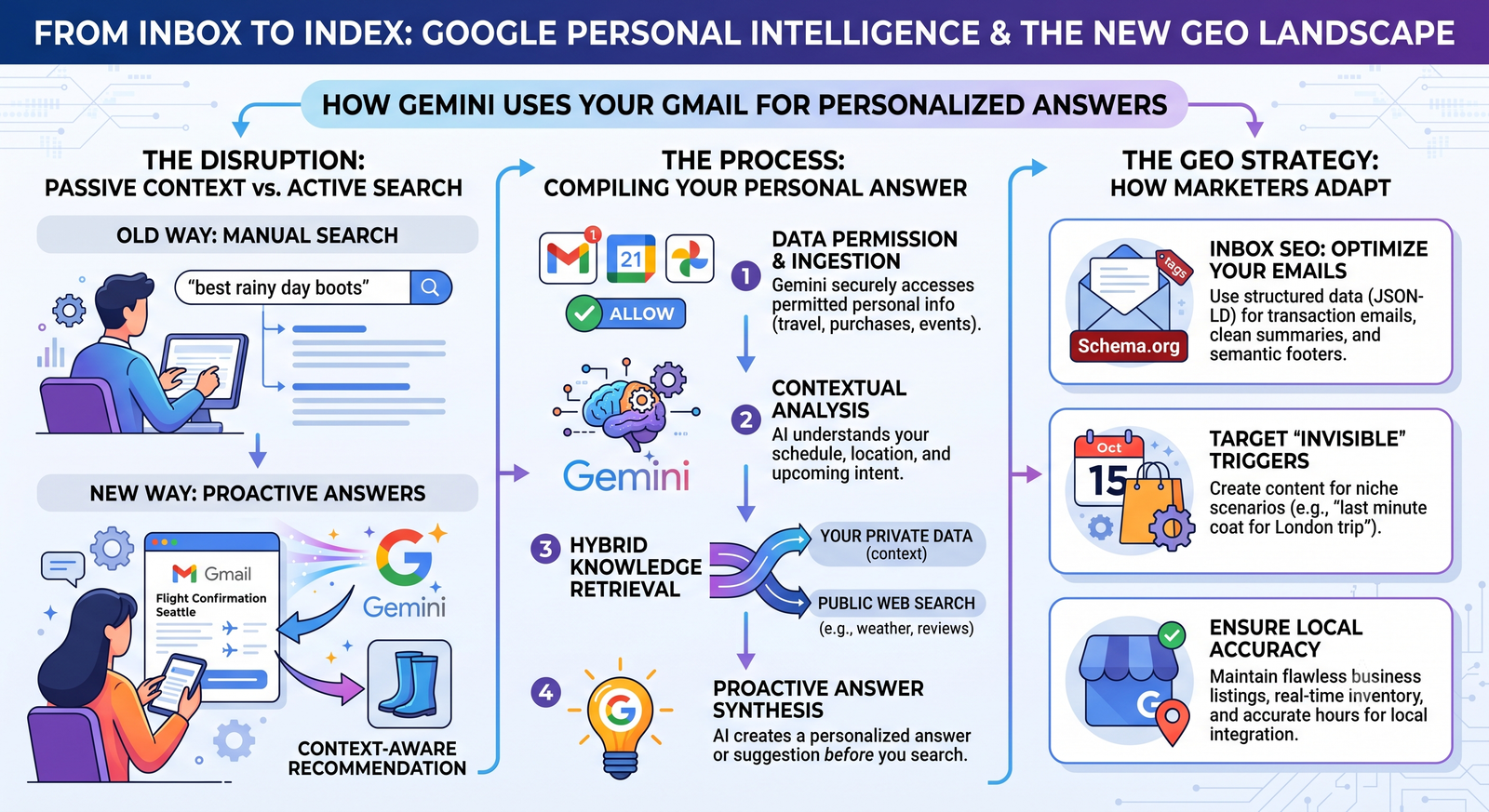
In the old days of SEO, a user had to manually type their intent into a search bar: “best hiking boots for rainy weather.” Today, Personal Intelligence eliminates the need for that search entirely. By utilizing passive context, Gemini can scan a user’s recent Gmail confirmations, realize they booked a flight to Seattle for next weekend, check the rainy forecast, and proactively suggest a pair of boots.
The user never typed a keyword. The search was triggered invisibly by a flight confirmation email.
The New Reality: Your public content is no longer competing against other websites in a vacuum. It is being filtered through the hyper-personalized lens of your customer’s actual life events.
From Inbox to Index: The Rise of “Inbox SEO”
If Gemini is using your customer’s emails to understand their context, then every transactional email, receipt, newsletter, and booking confirmation your brand sends is no longer just “customer retention.” It is a crawlable data asset.
If your brand sends messy, unstructured emails that an AI can’t read, you effectively become invisible to that user’s personal ecosystem.
| Old Email Strategy | New Personal Intelligence Strategy |
|---|---|
| Fluff & Images: Using heavy imagery and vague copy to look pretty. | Structured Schemas: Embedding clean text, Microdata, and Schema.org codes so Gemini can instantly map dates, prices, and locations. |
| Generic Footers: Standard copyright text. | Semantic Signatures: Explicitly stating your brand entity, location, and core services in clean text for AI parsing. |
The “Zero-Click” Funnel is Becoming Autonomous
We’ve been panicking about “zero-click searches” (where users get answers directly on the search page without clicking a website) for a while. But Personal Intelligence introduces something entirely new: Agentic Conversions.
Imagine Gemini notices a user has a business trip coming up via Gmail. It doesn’t just recommend a hotel; it pulls up three options that fit the user’s historic preferences, compares them, and offers to book it right there in the chat.
The traditional marketing funnel—landing pages, CTAs, email captures—is bypassed entirely. Your new target audience isn’t just the human consumer; it’s the AI agent making the decision on their behalf.
How to Future-Proof Your Brand Right Now
You don’t need to throw out your marketing strategy, but you do need to upgrade it for the age of Personal Intelligence. Here is your new playbook:
- Optimize Your Email Architecture: Treat your transactional emails like a landing page for robots. Use clean text, bullet points for key data (dates, order numbers, locations), and implement strict email schema.
- Own the Niche Long-Tail Scenarios: Stop trying to rank for broad terms. Write highly authoritative content for specific life events (e.g., “What to pack for an October business trip in Chicago”), because that is the exact level of detail Gemini will look for when matching a user’s inbox data to the public web.
- Keep Your Public Data Flawless: Ensure your Google Business Profile, product inventory feeds, and local directory listings are 100% accurate and up-to-date. If Gemini wants to recommend your restaurant for a dinner gap it found in a user’s calendar, it needs to know your exact hours and menu instantaneously.
The Bottom Line
The brands that win the next decade of digital marketing won’t just be the ones with the highest domain authority or the biggest ad budgets. They will be the brands that seamlessly integrate into the user’s daily digital trail.
If you can master the art of being readable, relevant, and structured—both on your website and inside the inbox—you won’t just rank on Google. You’ll become a permanent part of your customer’s personal intelligence.